 Business License

MVR vs TVR: Efficiency, Cost, and Application Guide
In the industrial evaporation field, energy-saving technologies have become critical for reducing operational costs and minimizing carbon emissions.
MVR (Mechanical Vapor Recompression) and TVR (Thermal Vapor Recompression) are the two primary vapor recompression technologies widely used today. Both systems recycle secondary vapor to reduce the need for fresh steam, but they operate based on different principles and are suited to different application scenarios.
MVR (Mechanical Vapor Recompression)
In MVR systems, a mechanical compressor (such as a roots blower or centrifugal compressor) compresses the secondary vapor generated during evaporation. This process raises the vapor’s pressure, temperature, and enthalpy. The recompressed vapor is then reused as the heat source in the evaporator’s heater, forming a closed-loop vapor cycle that significantly reduces the need for external steam.
Energy Saving Principle:
MVR (Mechanical Vapor Recompression) uses a mechanical compressor (centrifugal or Roots type) to recover nearly 100% of the secondary vapor generated during evaporation. The compressed vapor is then reused directly as the heating medium in the evaporator, forming a closed-loop system. Only a small amount of external steam is needed during start-up or for minor heat loss compensation during operation.
For materials with low boiling point elevation (such as pure water), the energy efficiency of an MVR system is equivalent to or better than an eight-effect evaporator, but with significantly less steam consumption.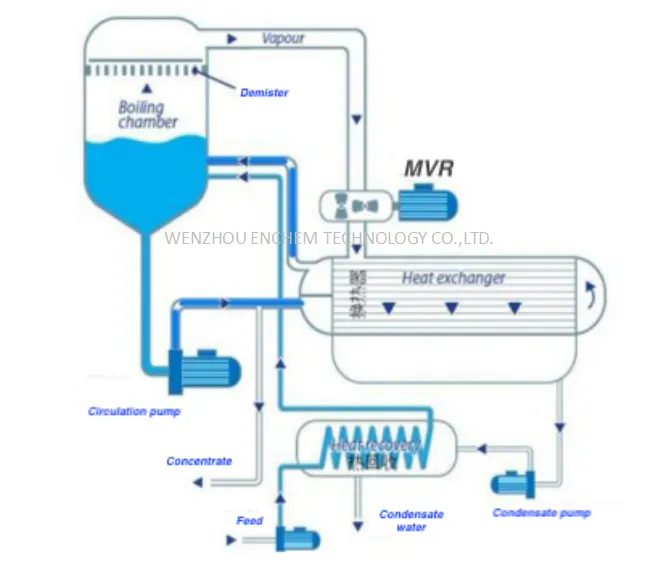
TVR (Thermal Vapor Recompression)
TVR uses a steam ejector (jet ejector) to recover part of the secondary vapor. By using high-pressure motive steam, the ejector entrains the low-temperature, low-pressure secondary vapor, mixes it with the motive steam, and compresses it. The resulting mixed vapor has higher temperature and pressure, allowing it to be reused as heating steam. This partially recycles thermal energy and reduces steam consumption.
Energy Saving Principle:
TVR (Thermal Vapor Recompression) uses a steam ejector to recover and recompress part of the secondary vapor produced during evaporation. Typically, the reuse rate of secondary vapor is about 30%–50%, reducing the consumption of fresh steam accordingly.
When compared to single-effect evaporation, TVR consumes approximately 60%–78% of the energy required to treat the same volume of solution (e.g., NaCl solution). This energy-saving performance is roughly equivalent to adding one additional effect in a multi-effect evaporator system.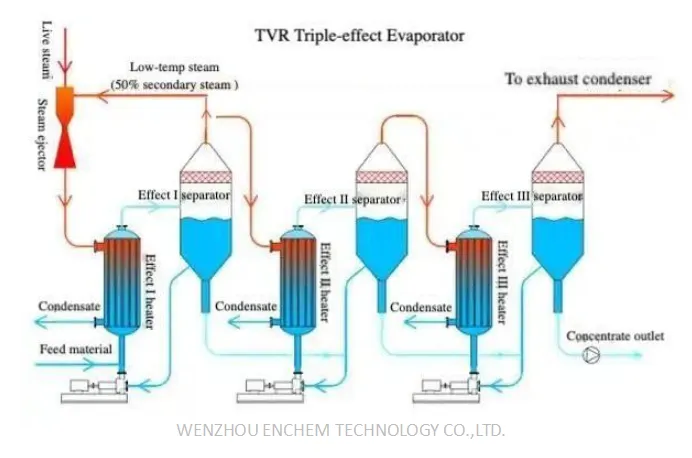
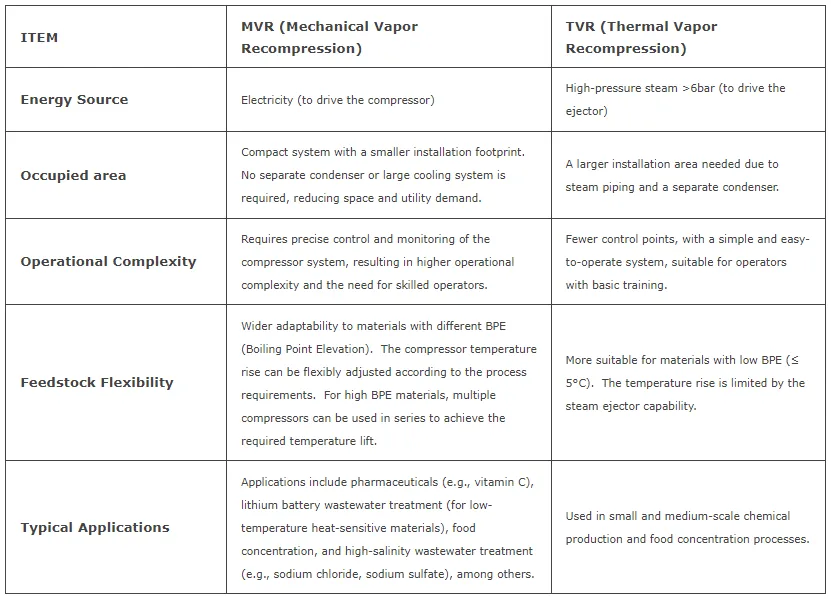 Application Recommendations
MVR (Mechanical Vapor Recompression)
MVR is ideal for projects that prioritize long-term energy savings, especially when electricity costs are below USD 0.09/kWh.
It is particularly recommended for:
• Limited installation space (compact footprint, no condenser required)
• Heat-sensitive or high-value materials (e.g., biopharmaceuticals, dairy products)
• Wastewater Zero Liquid Discharge (ZLD) applications
• Large-scale continuous operations where maximizing energy efficiency is essential
Despite its advantages, MVR systems require higher initial investment and involve greater technical complexity, especially in compressor operation and maintenance.
TVR (Thermal Vapor Recompression)
TVR is more suitable for applications where steam resources are abundant, the project budget is limited, and the material has a relatively low boiling point elevation (BPE).
Its simple design, low capital investment, and minimal maintenance make it an attractive option for plants looking to improve energy efficiency without significantly increasing system complexity.
MVR and TVR each have their own advantages. The optimal choice depends on the project’s scale, investment capability, energy costs, and operational requirements. A careful evaluation will ensure the best balance of economic and environmental performance.
Recently Posted
-
Benefits of a Secondary Fluidized Bed in a Calcium Chloride Spray Granulation Fluidized Bed Dryer
September 1, 2026Unlike conventional calcium chloride spray granulation fluidized bed dryer systems, our process incorporates a secondary fluidized Read More
 -
Application of Evaporator Technology in Zero Liquid Discharge (ZLD) Systems for Industrial Wastewate
September 1, 2026Industrial Wastewater Treatment SolutionsIndustrial wastewater is generated in a wide range of manufacturing processes and often c
Read More -
Comparison: MVR Evaporator vs. Multi-Effect Evaporator (MEE)
August 31, 2026MVR Evaporator OverviewMVR (Mechanical Vapor Recompression) evaporator is a high-efficiency, energy-saving evaporation system that
Read More -
MVR Evaporation and Crystallization
August 31, 2026What is MVR (Mechanical Vapor Recompression)?MVR (Mechanical Vapor Recompression) is an advanced, energy-efficient evaporation tec
Read More

Contact Us
Recommended Products
-
 Titanium Triple-effect Evaporator for Lithium Battery RecycleNegotiableMOQ: 1 Set
 -
Four-effect Falling Film Evaporator for Coffee Extract ConcentrationNegotiableMOQ: 1 Set
-
MVR Evaporator for Dyeing Wastewater TreatmentNegotiableMOQ: 1 Set
-
MVR Evaporator for Landfill Leachate TreatmentNegotiableMOQ: 1 Set
-
Triple-effect Forced Circulation Evaporator for Cobaltous Sulfate RecoveryNegotiableMOQ: 1 Set
-
Double-effect Countercurrent and Falling Film Evaporator for Caustic Soda ConcentrationNegotiableMOQ: 1 Plant
-
Double-effect Forced Circulation Evaporator for Calcium Chloride ConcentrationNegotiableMOQ: 1 Set
-
MVR Evaporator for Smelting Wastewater TreatmentNegotiableMOQ: 1 Set
-
Triple-effect Forced Circulation Evaporator for High Salinity Wastewater TreatmentNegotiableMOQ: 1 Set
-
Double-effect Central Circulation Evaporator for Metallurgy Effluent TreatmentNegotiableMOQ: 1 Set
-
Triple-effect Forced Circulation Evaporator for Mix Salt Wastewater TreatmentNegotiableMOQ: 1 Set
-
MVR Evaporator for Bio-pharmaceutical Wastewater TreatmentNegotiableMOQ: 1 Set
-
Calcium Chloride Solution Preparation and Refining PlantNegotiableMOQ: 1 Set
-
Vacuum Decompression Concentrator (Tank)NegotiableMOQ: 1 Set
-
Ammonium Sulfate Crystalline Powder Evaporation and Drying PlantNegotiableMOQ: 1 Set