 Business License

The Removal Rate Of COD In Evaporation Process
COD in wastewater is mainly determined by the amount of organic matter in wastewater. And the organic matter contained in wastewater may be high-boiling or low-boiling, If it was high boiling, it would enter the solid waste and waste liquid system with the salts during evaporation, and the COD of the condensate decreased; If it was low boiling, it would entered the condensate system during evaporation process, and the COD of the condensate did not go down. Therefore, the removal rate of COD in the evaporation process is related to the specific composition of organic matter in the wastewater. If the specific composition and content of organic matter can be provide, a basic judgment on the removal rate of COD in the evaporation process can be made, and the most scientific method is taking an evaporation test to check the removal rate of COD in the evaporation process.
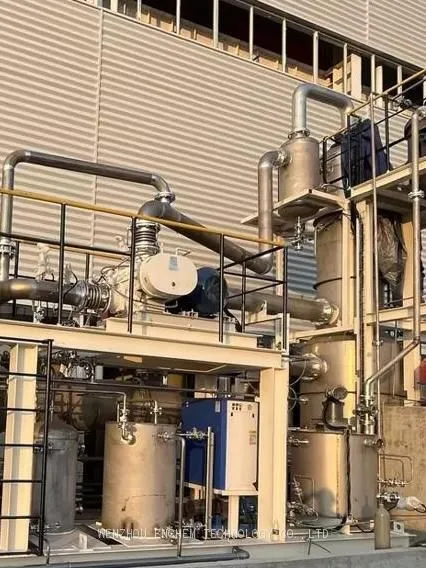
Enchem technology always makes an evaporation experiment to simulate the practical evaporation process before designing and manufacturing of the evaporator system. The contents of the evaporation experiment include the following item:
1. pH of the wastewater: it is suggested to regulate the pH of the wastewater to neutral which is more friendly to construction material;
2. Specific gravity of the wastewater, which is important consideration for determining the specification and type of pumps of the evaporator system;
3. Boiling point of wastewater under atmospheric pressure and vacuum pressure;
4. Observe the state of wastewater at different concentration, and;
5. Check the state of the condensate, and the material of the condensate system can be determined accordingly.
With the above experimental results, an appropriate and optimized evaporator system can be designed and made.
Recently Posted
-
Comparison of DTB, Oslo, and FC Crystallizers: Principles, Characteristics, and Applications
August 12, 2026AbstractIndustrial crystallization is widely used in chemical, fertilizer, pharmaceutical, and wastewater treatment industries for Read More
 -
Liquid Ring Vacuum Pumps in Evaporation System
August 12, 2026AbstractVacuum systems play a crucial role in industrial evaporation processes by reducing operating pressure and enabling low-tem
Read More -
Achieving Low Residual Moisture Content in Industrial Salt Crystallization Processes
August 12, 2026The Importance of Low Residual Moisture ContentIn industrial crystallization and salt production processes, achieving low residual
Read More -
Successful Commissioning of Instant Coffee Liquor 4-Effect Evaporator Upgrading Project in Indonesia
August 11, 2026We are proud to announce the successful commissioning of an Instant Coffee Liquor 4-effect evaporator upgrading project in Indones
Read More

Contact Us
Recommended Products
-
 MVR Distillation TechnologyNegotiableMOQ: 1 Set
 -
Potassium-Sodium Separation EvaporatorNegotiableMOQ: 1 Set
-
Barium Chloride Evaporation and Crystallization System for Industrial ProductionNegotiableMOQ: 1 Set
-
Industrial Multi-Effect Evaporation Crystallization System for Barium Chloride ProductionNegotiableMOQ: 1 Set
-
Five-effect Falling Film Evaporator for HFCS ConcentrationNegotiableMOQ: 1 Set
-
Hybrid Calcium Chloride Concentration Evaporator SystemNegotiableMOQ: 1 Set
-
Containerized Low-Temperature Heat Pump Crystallization EvaporatorNegotiableMOQ: 1 Set
-
Containerized Low-Temperature Heat Pump Concentration EvaporatorNegotiableMOQ: 1 Set
-
Containerized MVR EvaporatorNegotiableMOQ: 1 Set
-
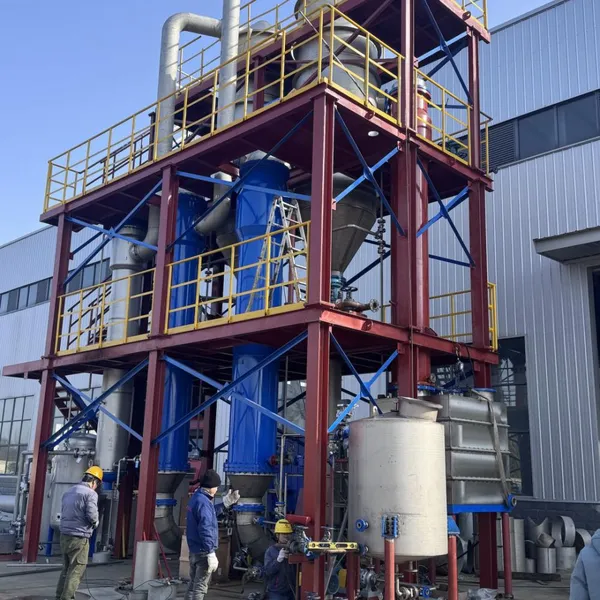
4-Effect TVR Evaporator for Instant Coffee ProductionNegotiableMOQ: 1 Set
-
MVR Evaporator System for Lithium Battery Black Mass Leachate CrystallizationNegotiableMOQ: 1 Set
-
Battery-Grade Nickel Sulfate Hexahydrate Evaporation & Crystallization PlantNegotiableMOQ: 1 Set
-
Waste Hydrochloric Acid Recycling Solution and Calcium Chloride Production SolutionNegotiableMOQ: 1 Set
-
Anhydrous Calcium Chloride Granulation & Drying SystemNegotiableMOQ: 1 Set
-
Skid-Mounted MVR Evaporator SystemNegotiableMOQ: 1 Set
-
MVR Evaporator for Anhydrous Sodium Sulfate (Na₂SO₄) ProductionNegotiableMOQ: 1 Set
-
Ethanol Recovery System (Ethanol Recovery From Waste Liquid Soap)NegotiableMOQ: 1 Set
-
MVR Evaporator for Lithium Sulfate ConcentrationNegotiableMOQ: 1 Set
-
MVR EvaporatorNegotiableMOQ: 1 Set
-
MVR Evaporator for Smelting Wastewater TreatmentNegotiableMOQ: 1 Set