 Business License

COMMON-USED MVR: ROOTS COMPRESSOR
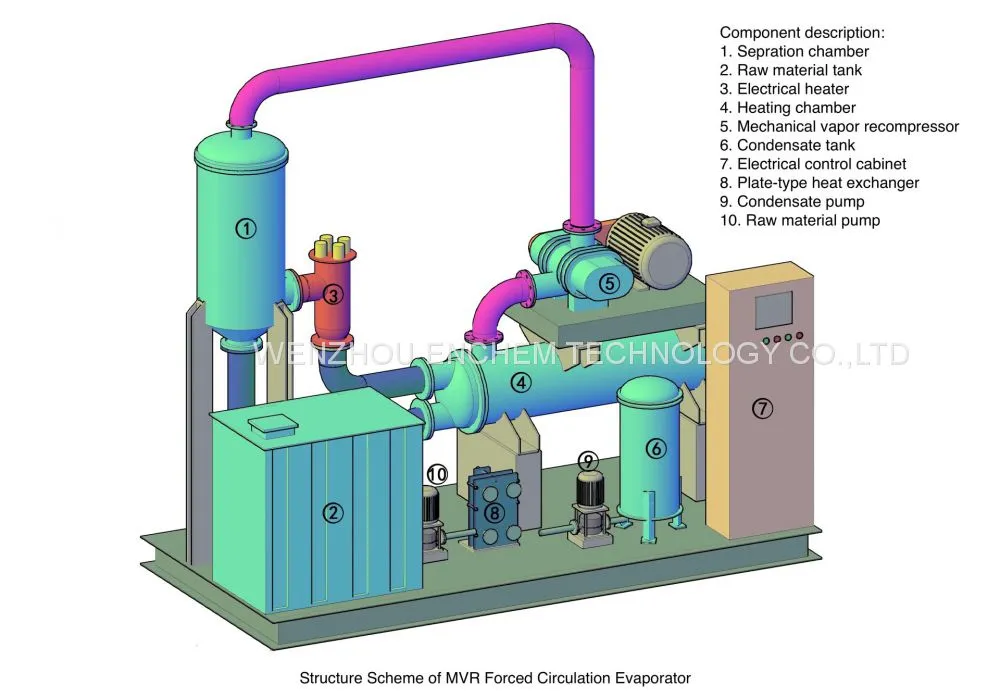
The commonly used vapor compressors mainly include: Roots compressor, axial flow compressor, centrifugal fan and centrifugal compressor. The centrifugal compressor is a speed type blower, providing a small differential pressure, and of large single unit capacity. And the Roots compressor is mainly used for small flow conditions.
The roots compressor is based on same principle as the conventional roots type blower, is displacement type blower, and the air delivery capacity is proportional to the rotating speed. A small gap is always maintained between the impeller end face and the front and rear end covers of the fan and between the fan impellers. Driven by the synchronous gear, the air is conveyed from the air inlet along the inner wall of the casing to the outlet side. And it is steam conveyed in the roots compressor instead of air.
The roots compressor is able to provide an effective temperature rise up to 25°C(in the case of water vapor), it is suitable for working condition of smaller evaporation capacity and bigger boiling point elevation. Generally, Roots compressors can be used for conditions of evaporation capacity no greater than 8 ton/hour and the boiling point elevation no exceed 25°C.
Recently Posted
-
Can MVR Evaporators Be Used for Calcium Chloride Concentration?
September 2, 2025Calcium chloride is a versatile product — from anhydrous granules to dihydrate flakes — but its high solubility, high boiling poin Read More
 -
MVR vs TVR: Efficiency, Cost, and Application Guide
July 14, 2025In the industrial evaporation field, energy-saving technologies have become critical for reducing operational costs and minimizing
Read More -
Congratulations on Successful Commissioning of Potassium-Sodium Separation Four-Effect Evaporator
July 10, 2025OverviewWe are pleased to announce that the Potassium-Sodium Separation Four-Effect Evaporator System, engineered and delivered by
Read More -
What Is an FC Crystallizer? Design, Working Principle, and Applications
June 24, 2025When crystallizers are classified based on the mode of material circulation, the three most commonly used types are External
Read More

Contact Us
Recommended Products
-
 Potassium-Sodium Separation EvaporatorNegotiableMOQ: 1 Set
 -
Barium Chloride Evaporation and Crystallization System for Industrial ProductionNegotiableMOQ: 1 Set
-
Industrial Multi-Effect Evaporation Crystallization System for Barium Chloride ProductionNegotiableMOQ: 1 Set
-
Five-effect Falling Film Evaporator for HFCS ConcentrationNegotiableMOQ: 1 Set
-
Hybrid Calcium Chloride Concentration Evaporator SystemNegotiableMOQ: 1 Set
-
Containerized Low-Temperature Heat Pump Crystallization EvaporatorNegotiableMOQ: 1 Set
-
Containerized Low-Temperature Heat Pump Concentration EvaporatorNegotiableMOQ: 1 Set
-
Containerized MVR EvaporatorNegotiableMOQ: 1 Set
-
4-Effect TVR Evaporator for Instant Coffee ProductionNegotiableMOQ: 1 Set
-
MVR Evaporator System for Lithium Battery Black Mass Leachate CrystallizationNegotiableMOQ: 1 Set
-
Battery-Grade Nickel Sulfate Hexahydrate Evaporation & Crystallization PlantNegotiableMOQ: 1 Set
-
Waste Hydrochloric Acid Recycling Solution and Calcium Chloride Production SolutionNegotiableMOQ: 1 Set
-
Anhydrous Calcium Chloride Granulation & Drying SystemNegotiableMOQ: 1 Set
-
Skid-Mounted MVR Evaporator SystemNegotiableMOQ: 1 Set
-
MVR Distillation TechnologyNegotiableMOQ: 1 Set
-
MVR Evaporator for Anhydrous Sodium Sulfate (Na₂SO₄) ProductionNegotiableMOQ: 1 Set
-
Ethanol Recovery System (Ethanol Recovery From Waste Liquid Soap)NegotiableMOQ: 1 Set
-
MVR Evaporator for Lithium Sulfate ConcentrationNegotiableMOQ: 1 Set
-
MVR EvaporatorNegotiableMOQ: 1 Set
-
MVR Evaporator for Smelting Wastewater TreatmentNegotiableMOQ: 1 Set